
Children’s Grief-Play Therapy
Grief has no schedule, especially not a child’s.
Play is how children process what they don’t yet have words for. This is a quiet, structured space where your child can grieve at their own pace, with someone trained to follow them there.

Understanding Grief Play Therapy
What grief play therapy is
Children often don’t have the vocabulary (or the patience) to sit and talk through a loss the way an adult might. Play gives them another way in. Through sand, story, art, and pretend, a child can show what they’re carrying, at whatever pace feels safe, without ever being asked to explain it in words first.
This isn’t unstructured free play, and it isn’t a lesson dressed up as a game. It’s a specific, trained approach: following the child’s lead while staying attentive to what their play is telling us, and gently helping them move through, not around, what they’re feeling.
Who it’s for
This work is for children and younger teens who are grieving a loss (a parent, grandparent, sibling, friend, or pet), whether the loss was sudden or something the family saw coming. It’s for kids who seem “fine” one moment and fall apart the next, kids who’ve stopped wanting to talk about it at all, and kids whose grief is showing up sideways: in sleep, in school, in play that keeps circling back to the same themes.
There’s no “right” amount of grief that qualifies a child for this kind of support. If a loss has touched your family and you’re not sure whether what you’re seeing is normal or something more, that uncertainty itself is a good enough reason to reach out.
The adults in the family are often carrying this loss too. If your own grief needs a place as well, Bryna also works with grieving adults and young adults: see grief counseling, or go straight to the loss of a spouse or a parent, or grief that stays intense and won’t ease.
Grief can show up in unexpected places: sometimes it isn’t tears or big questions about death, but a child who suddenly doesn’t want to read, or whose schoolwork stops making sense the way it used to. If you’ve noticed something like that since a loss, it can help to move gently and in order: first, take some time as a family to reflect on what you’re seeing, both at home and in the school day; then reach out to your child’s teachers and talk through what they’re noticing in the classroom. And whenever you’re ready, you’re always welcome to talk it through with Michael, whose page on the signs a child may be struggling with reading walks through what that can look like, alongside whatever grief support your family needs.
What this looks like for older kids and teens
Play therapy the way most people picture it (sand trays, pretend, dress-up) is built around younger children. Older kids and teens grieve just as hard, but they usually don’t want to play pretend, and they don’t always want to sit and talk about it either. For this age group, the work looks different. It’s activity-based: games, art, building something with their hands, or just moving around, rather than pretend-play.
The activity itself isn’t really the point. It’s a way to be in the room together without the pressure of eye contact and direct conversation, so whatever’s underneath has room to come out sideways, in its own time. The goal is the same as it is for younger children: meeting a grieving kid where they actually are, not where a textbook says they should be.

The Room & How Sessions Work
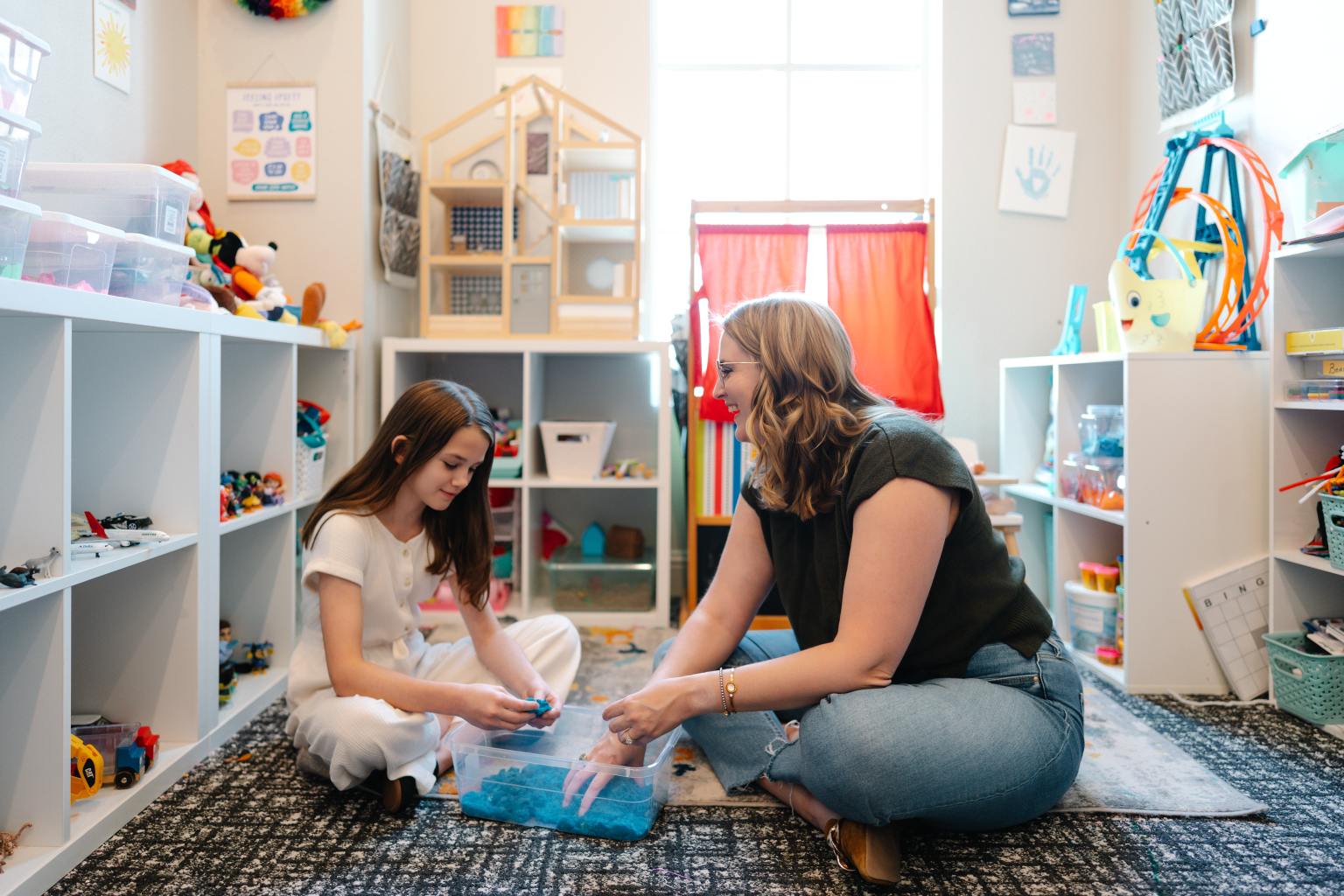
A real space, not a stock photo
This is the room your child will actually sit in: not a stock photo, not a generic playroom. It’s set up specifically for this work: room to move, materials a child can reach without asking, and enough quiet that whatever comes up has space to.
How sessions work
For the first session, you’ll be there at the start with your child. After that, whether you stay is worked out in the moment, based on what your child needs. From the second session on, sessions are usually just your child and their therapist, with you right outside in the waiting room the whole time. (If family therapy turns out to be the right fit for your situation, sessions look different, and we’ll talk through that together first.)
Sessions happen in person at our Plano office, or virtually. Bryna offers telehealth sessions statewide, anywhere in Texas.
Curious what the whole process looks like, from your first message to your first session? See what to expect.
More From the Blog
Read more about children’s grief
- Child Grief Awareness: how childhood grief differs from adult grief, and why honesty with kids matters.
- Back to School: A Guardian’s Guide to Helping a Grieving Child: practical support for a grieving child returning to the classroom.
- Grief Monsters: an externalizing exercise for naming big feelings, one of the tools we use in session.
Parent FAQ
Questions parents ask us first
What is grief play therapy, and how is it different from just talking to my child about the loss?
Grief play therapy uses play (sand, art, story, pretend) as the main way a child processes loss, instead of relying on conversation the way adult therapy might. Many children don’t yet have the words or the willingness to talk directly about what happened, but they can show it through play. A trained therapist follows that play closely and gently helps the child move through what they’re feeling.
What ages is this appropriate for?
This approach is generally used with younger children and can extend into the early teen years, depending on the child. Play remains a natural way for many kids to process big feelings well beyond early childhood. The right fit depends on the individual child, not a strict age cutoff.
Is it normal for my child to seem “fine” one day and fall apart the next?
Yes. Children grieve in bursts, not in a straight line: a child can play happily one hour and be inconsolable the next, and both are part of the same process. That unevenness is expected, not a sign that something is wrong.
What if my child doesn’t want to talk about what happened?
They don’t have to. Play-based grief therapy doesn’t require a child to narrate their feelings in words: the play itself does that work, at whatever pace the child sets.
How long does grief play therapy usually take?
Every child’s timeline is different, and it depends on the loss, the child’s age, and what else is going on in their life. Rather than promise a fixed number of sessions up front, we talk honestly about pacing once we’ve had a few sessions together and have a clearer picture.
Do I need to be in the room with my child during sessions?
For the first session, you’ll be there at the start with your child. After that, whether you stay for the rest of it is worked out in the moment, based on what your child needs. From the second session on, sessions are usually just your child and their therapist, with you right outside in the waiting room the whole time, which gives your child their own space to work through what they’re feeling, without an audience. (If family therapy turns out to be the right fit for your situation, sessions look different, and we’ll talk through that together before it happens.) Either way, you’re never far, and we’ll keep you in the loop on how things are going.
What if the loss was a pet instead of a person? Does play therapy still help?
Yes. Grieving a pet is a real loss, and children often feel it as deeply as any other loss in their life. The same play-based approach applies.
How do I know if my child needs this, or if what I’m seeing is within a normal range of grief?
There’s no simple checklist that draws a clean line between “normal” grief and grief that needs support, and you don’t need to be certain before reaching out. If you’re unsure, that uncertainty is itself a reasonable enough reason to ask.
Who you’ll meet

- Licensed Marriage and Family Therapist (LMFT)
- LMFT with extensive specialized training in play therapy
- Practicing since 2017; opened Talamantez Therapy in 2021
- Serving grieving families across Plano and North Texas
As featured in Plano City Lifestyle: “When Festive Lights Cast Shadows: A Guide to Holiday Grief” by Bryna Talamantez.

DFW Child Mom Approved · 2023–2026
Ready to talk?
Reach out and we’ll find a time that works for your family.
Free 15-minute consultation by phone, then $150 per session — in person at our Plano office, or virtually, anywhere in Texas.